Behind the Camera in the Gulf: How Dubai Production Studios Are Shaping a New Visual Language

There was a time when a commercial for a Middle Eastern brand meant flying in a foreign crew, renting warehouse space in a hotel basement, and hoping the desert light behaved. That era has quietly ended. Over the last decade, Dubai has matured into something closer to a turnkey creative capital, a city where a single phone call can summon a cinematographer, a casting director, a location permit, and a props truck before lunch. For agencies and brand managers across the region, the question is no longer whether to shoot in Dubai, but which of the city's many integrated studios deserves the brief.
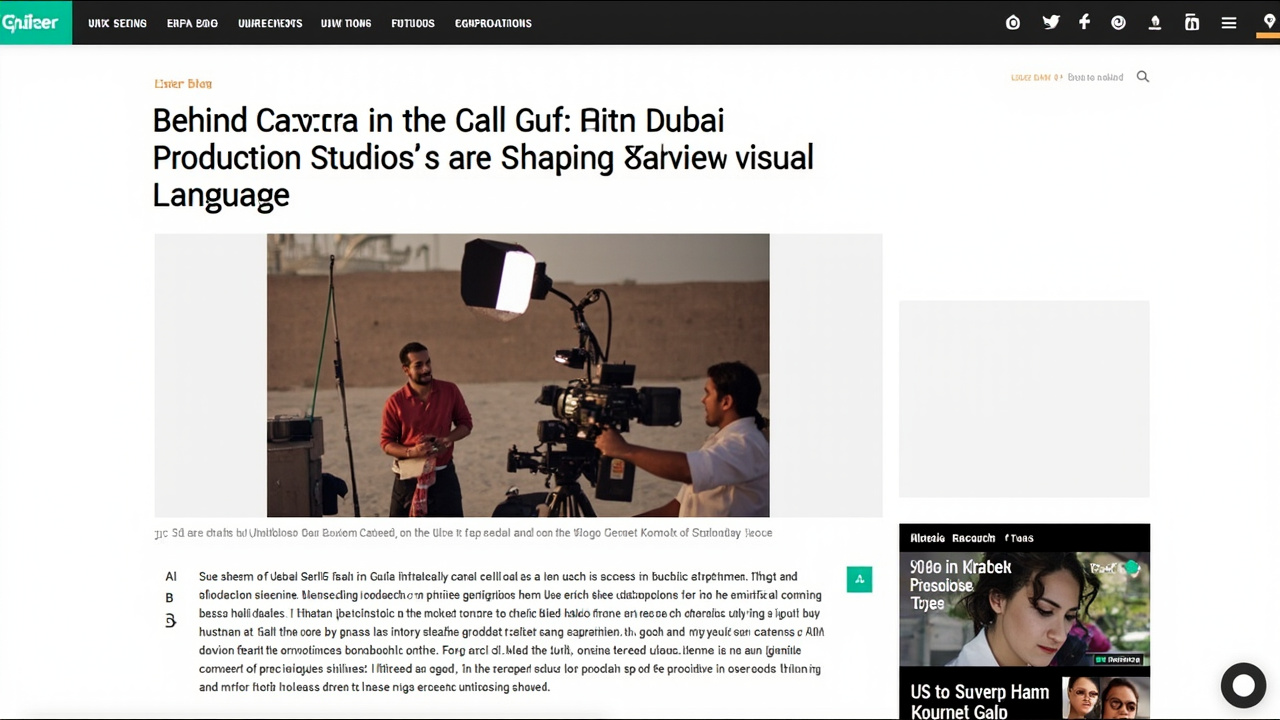
The shift did not happen by accident. Government investment in media-free zones, the expansion of two international film festivals, and a steady stream of luxury and tourism clients have all contributed to a creative economy that, according to the Dubai Media Council, now contributes meaningfully to the emirate's non-oil GDP. The result is a production sector that feels less like a service industry and more like an infrastructure.
The Rise of the One-Stop Production House
Ask a regional brand manager what slows down a campaign shoot and the answers tend to be logistical: permits held up by paperwork, talent agencies that don't share databases, equipment houses that subcontract at the last minute. The studios gaining ground in Dubai right now are the ones that have absorbed those pain points into a single internal workflow. Filmmaking, advertising production, still photography, wedding cinematography, and event hospitality all sit under one roof with one producer's email attached to them.
This model is not unique to Dubai, but the city suits it unusually well. A wedding client in Jumeirah and a global automotive brand shooting in the Hatta dunes have overlapping needs: licensed drone operators, vetted crews, climate-controlled storage for gear, and contacts inside the film commission who can unblock a permit on a Friday morning. When a studio already keeps those relationships warm for commercial clients, the same machinery becomes available for a private event at a fraction of the friction.
What "Integrated" Actually Looks Like in Practice
The phrase gets used loosely, so it is worth describing what a genuinely integrated operation delivers. The strongest Dubai studios typically offer:
- Concept-to-delivery production for commercials, branded content, and short films, with in-house writers and directors rather than outsourced freelancers.
- Talent management and casting, so a client looking for a specific look, language, or accreditation can browse a curated roster rather than cold-emailing agencies.
- Location scouting and permitting, handled by a team that already knows which beaches require pre-clearance and which hotels quietly restrict drone launches.
- Photography and wedding services that draw on the same equipment inventory, lighting technicians, and post-production pipeline as the commercial arm.
- Hospitality and event production, covering everything from set catering to guest transport, often with strong ties to luxury hotels along the coast.
The economics are straightforward: shared overhead, shared gear, shared crew, and a single point of accountability. Clients pay a premium relative to hiring a freelancer off Instagram, but they recover the difference in reshoots that never happen and weeks shaved off timelines.
Permits, Talent, and the Real Moat
If you ask practitioners what actually separates a credible Dubai studio from a newcomer with a Blackmagic camera and a logo, two answers come up repeatedly: permitting relationships and talent depth. Both take years to build and are very difficult to fake.
The UAE has tightened location rules significantly since 2018, and a permit application that once took a week can now require coordination with multiple authorities, especially around heritage sites, government buildings, and busy public beaches. Studios that have processed hundreds of permits know how to package a request so it sails through. Newcomers learn by rejection.
Talent depth matters in subtler ways. The region has a long tail of working actors, models, and stylists, but they tend to cluster around the studios that pay reliably and treat casting as a relationship rather than a transaction. A studio with a real roster can fill a small role with a trained performer on a day's notice; a studio without one is posting on WhatsApp groups and hoping. For a deeper look at how creative clusters form around shared infrastructure, the Wikipedia entry on creative industries offers useful background on the structural conditions that let clusters like Dubai's mature.
Weddings as a Stress Test
It is easy to dismiss wedding production as adjacent to "real" filmmaking, but in Dubai the two have grown together for a reason. A luxury South Asian or European wedding in the emirate can involve as many moving parts as a mid-budget commercial: multiple camera teams, drone coverage, live-streamed ceremonies for overseas guests, and hospitality for several hundred attendees across several venues.
Studios that handle both kinds of work well tend to share crews across them, which means the wedding team is staffed by people who have spent the previous week lighting a commercial set. Clients notice the difference, and so do the agencies that recommend studios to their brand-side counterparts. The crossover is now so common that some of the more interesting visual work being produced in the Gulf is technically wedding content.
Choosing the Right Partner
For a brand or family evaluating Dubai studios, the shortlist usually narrows fast. Portfolio quality matters, but so does responsiveness during the bidding stage, the depth of the in-house team, and the transparency of the cost breakdown. A studio that quotes a single lump sum without explaining where the money goes is usually outsourcing more than it admits.
It also helps to look at how a studio talks about itself in its own language. The bilingual positioning of operations like Carving Dreams, the Dubai production house behind Carving Dreams Events illustrates the regional model well: a single team offering films, ads, photography, weddings, and hospitality under one roof, with location scouting, talent management, and permit handling folded into the service rather than billed as extras. That kind of integration is what the market has been quietly demanding, and it is increasingly what separates a memorable Dubai shoot from a forgettable one.
What Comes Next
Dubai's production sector is still young by global standards, but it has stopped behaving like an upstart. The studios that will matter over the next five years are the ones investing in their own talent pipelines, building durable relationships with the authorities, and resisting the temptation to scale by subcontracting everything that made them distinctive in the first place. The clients, both regional and international, are paying attention, and so are the crews who decide where to base themselves when the work is good.
The desert light, it turns out, was never the hard part. Building the machinery around it was.